
Boxer Leg Hemming Machine
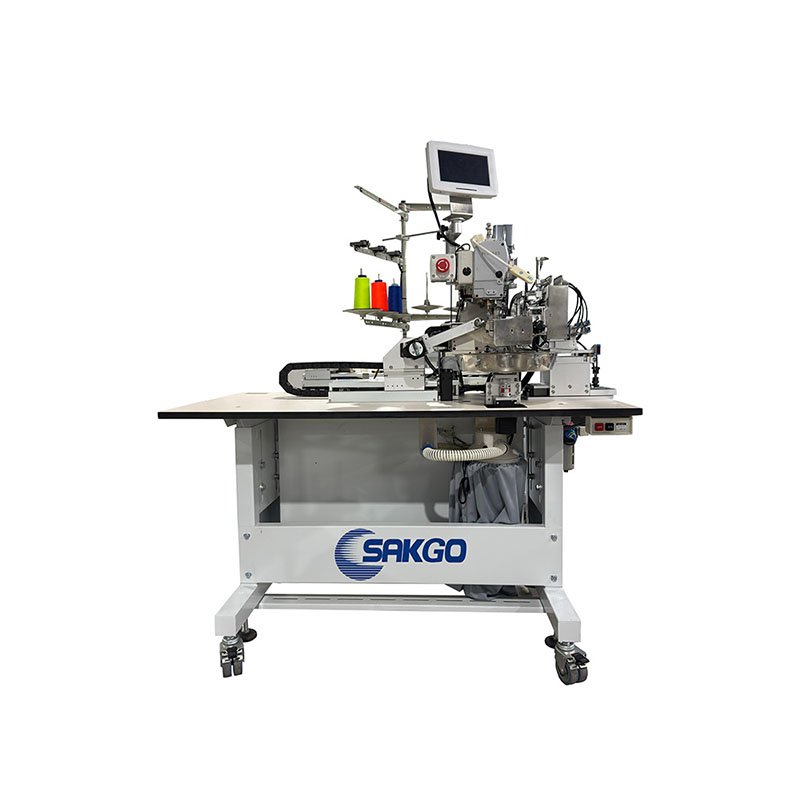
Boxer Leg Hemming Machine
The SAKGO SK-1129 is a fully automated boxer leg hemming machine designed for men’s boxer briefs, trunks, and shorts. Covering a seam range of 18–40 cm, it delivers 3500 RPM sewing speed and 180–240 pieces per hour with a small-barrel WT264P-35NB head — producing clean, consistent leg hems on all standard men’s underwear leg openings with no skilled operator required.
Code
SK-1129
Sewing Range:
18 – 40 cm
Max Speed
3500 RPM
Capacity
180 – 240 pcs / hr
Capacity
>4 Bar
Needle Pitch
5.6 mm
Key Features
1. Small-Barrel WT264P-35NB Head The WT264P-35NB head is engineered for small cylindrical sewing operations — precisely matched to the narrow tubular form of boxer leg openings. This prevents the fabric distortion and feed irregularities that occur when using standard flat or large-barrel heads for leg hem operations.
2. 18–40 cm Seam Coverage Covers the full range of standard men’s underwear leg opening circumferences — from small to extra-large sizes — in a single machine configuration without mechanical adjustment between sizes.
3. Differential Upper/Lower Feed The differential upper and lower feed mechanism handles the tubular leg opening form consistently, preventing stretching, puckering, and misalignment throughout the hemming cycle. Delivers clean, even hems on all standard knitted underwear fabrics.
4. 3500 RPM High-Speed Operation At 3500 RPM, the SK-1129 produces 180–240 finished pieces per hour — providing the consistent high output required for volume men’s underwear production.
5. Fully Automated Hem Cycle The complete leg hemming cycle — fabric positioning, hem folding, sewing, and thread trimming — runs automatically without operator intervention between pieces. Operators focus on garment loading and output monitoring only.
6. Skill-Free Operation No technical sewing skill is required to operate the SK-1129. The automated feed and hemming system handles all precision tasks, allowing new operators to reach full production output within one day of training.
7. Stable Dimensions for Downstream Efficiency Consistent leg hem dimensions ensure finished pieces feed accurately into subsequent operations — waistband attachment, labelling, and packaging — without correction or rework, improving total line throughput.
8. CE & ROHS Certified Meets European CE and ROHS certification standards — suitable for export-oriented factories supplying global men’s underwear and apparel brands.
Product Inquiry
Common Questions
Frequently Asked Questions
Everything you need to know about SAKGO’s T-shirt and polo shirt
automation machines before making a purchasing decision.
The SK-1129 is purpose-built for boxer leg hemming — the operation of finishing the leg openings on men's boxer briefs, trunks, and boxer shorts. It automates the complete hemming cycle on the narrow tubular leg opening form, replacing the skilled manual labour traditionally required for this operation.
The machine covers a seam range of 18–40 cm — accommodating standard men's underwear leg opening circumferences from small through to extra-large sizes without mechanical adjustment between sizes.
The WT264P-35NB is a small-barrel head type specifically designed for narrow cylindrical sewing operations. Boxer leg openings are small-circumference tubular forms — a large or flat head cannot feed this shape correctly. The WT264P-35NB ensures the fabric feeds smoothly and consistently through the hemming cycle without distortion, stretching, or misalignment.
The SK-1129 is designed for knitted fabrics — including single jersey, interlock, cotton-blend knitwear, and stretch fabrics commonly used in men's underwear and boxer short production. The differential upper/lower feed handles elastic and stretch fabrics without distortion.
The machine requires compressed air at greater than 4 Bar. Ensure your factory compressor meets this minimum pressure before installation.
Yes. Because the leg hemming cycle is fully automated, one trained operator can load garments and monitor 2–3 SK-1129 machines simultaneously — significantly reducing the labour cost per finished piece compared to manual hemming operations.